Collaborative research & experimental support
Drosophila Functional Genomics Core
Connecting human genetics with experimental insight.
We work with clinicians, geneticists, and research collaborators to investigate the biological effects of human genetic variants using Drosophila. Alongside collaborative disease research, we provide project consultation, experimental design, and execution tailored to each research question.
Working with the Core
Custom Drosophila Research Services
Consultation, experimental design, and execution tailored to your research question.
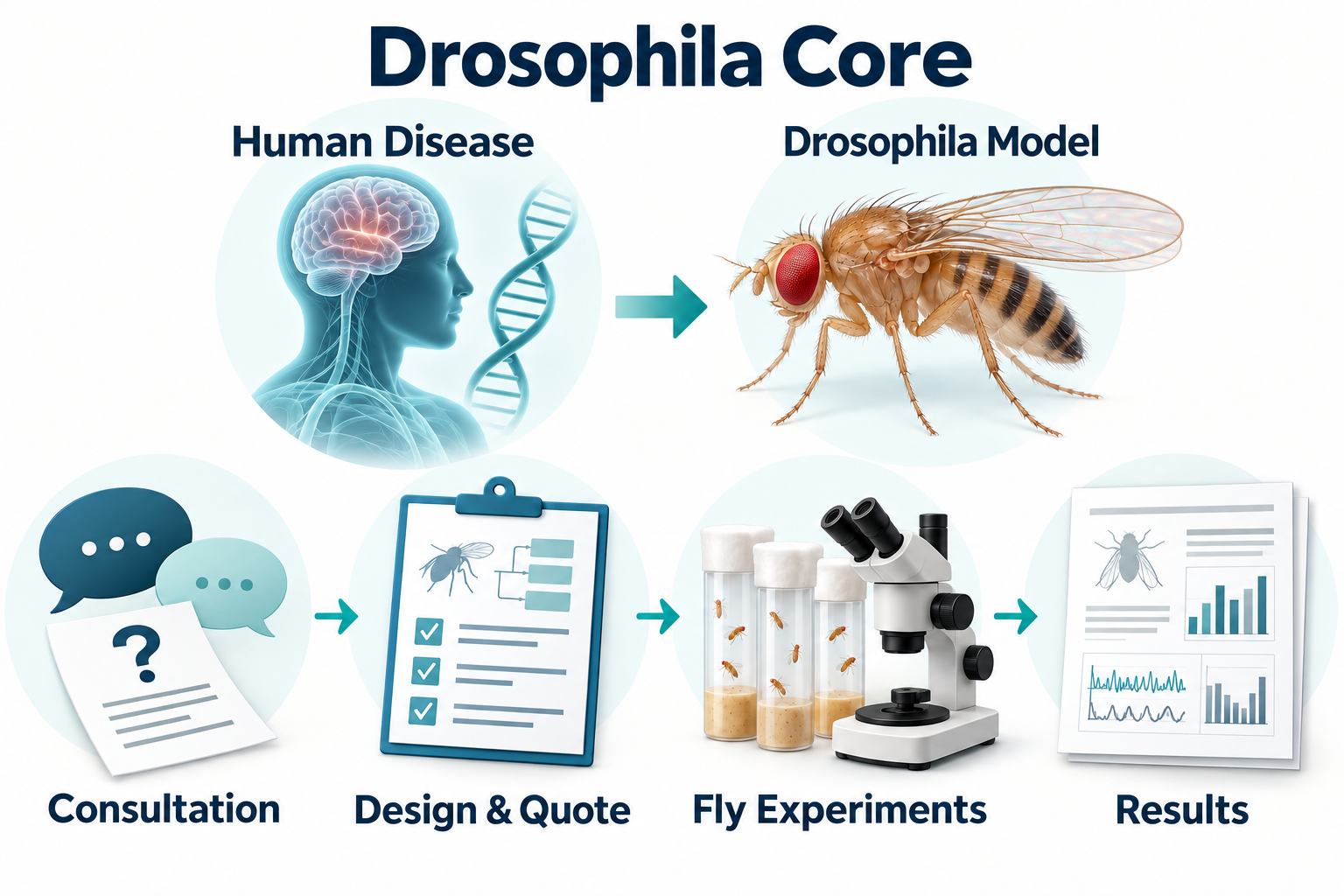
We provide customized Drosophila research services for clients and collaborators who need fly models and experiments tailored to their scientific questions. We advise on experimental options, design a project around your goals, and carry out the work.
Each project begins with a conversation. We provide a tailored scope of work and a custom quote based on your needs.
Collaborating across borders
We have ongoing projects with collaborators within Houston Methodist and with research teams in Switzerland, Qatar, Israel, and Korea.
Need a fly model? Let’s start with your question.
Scientific expertise
Rare Disease Genetics and Human Variant Studies
Our scientific expertise draws on Dr. Chung’s collaborative research connecting rare human genetic variants with their biological effects. Drosophila provides an experimental system for testing how patient-derived variants change gene function, development, behavior, and nervous system maintenance. Combining human genetic findings with functional studies helps establish gene–disease relationships and distinguish different molecular mechanisms.
Recent studies have investigated MARK2 variants associated with neurodevelopmental disorders and DDX23 gain-of-function variants linked to autism, intellectual disability, motor delay, and seizures. Earlier work connected EMC1 variants with neurodevelopmental delay, cerebellar degeneration, and altered glial function. These collaborations support variant interpretation and reveal pathways that can guide future disease research.
Collaborative studies published in 2020 and 2026 also connect CDK19-associated neurodevelopmental disorders with functional changes in patient-derived variants tested in vivo, helping clarify disease mechanisms.
Selected collaborative studies
- Koh HY, et al. Identification of novel CDK19 variants and Drosophila-based in vivo functional evidence supporting pathogenicity in neurodevelopmental disorders. Genetics in Medicine. Published online October 1, 2026;102735.
- Yang Y, et al. Loss-of-function variants in MARK2 cause neurodevelopmental disorder. HGG Advances. 2026;7(3):100600.
- Sahu RK, et al. DDX23 gain-of-function linked to autism spectrum disorder with intellectual disability, motor delay, and seizure. Genetics in Medicine Open. 2026;4:104484.
- Chung HL, et al. De novo variants in EMC1 lead to neurodevelopmental delay and cerebellar degeneration and affect glial function in Drosophila. Human Molecular Genetics. 2022;31(19):3231–3244.
- Chung HL, et al. De Novo Variants in CDK19 Are Associated with a Syndrome Involving Intellectual Disability and Epileptic Encephalopathy. American Journal of Human Genetics. 2020;106(5):717–725.
Explore the Chung Lab’s research
Learn about the lab’s studies of lipid metabolism, glial biology, and mitochondrial dynamics.